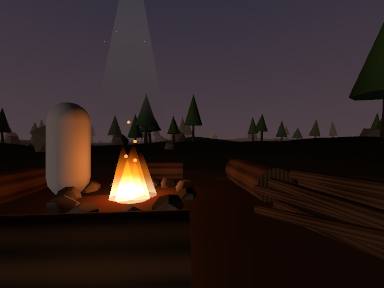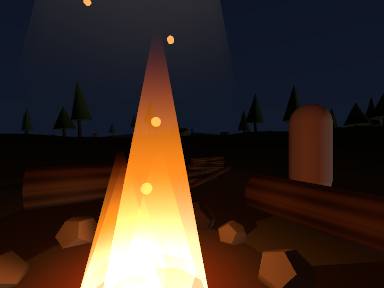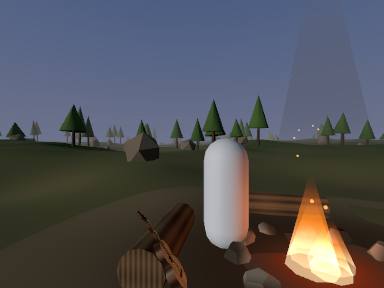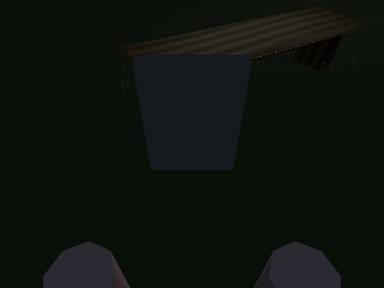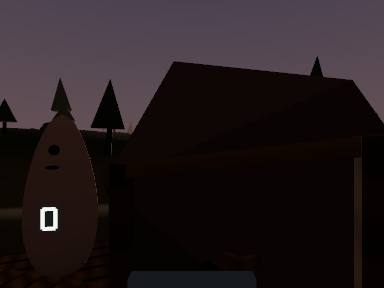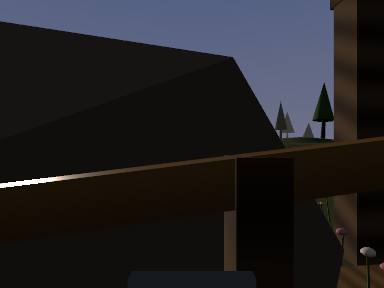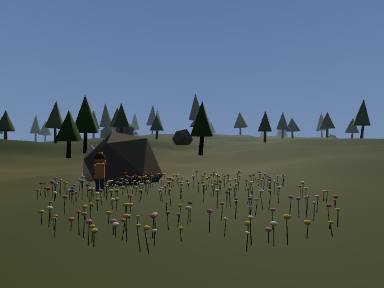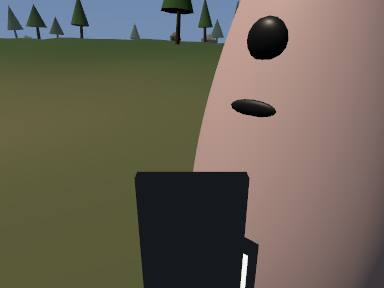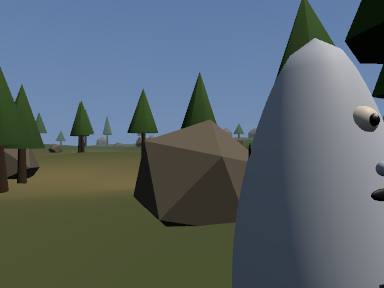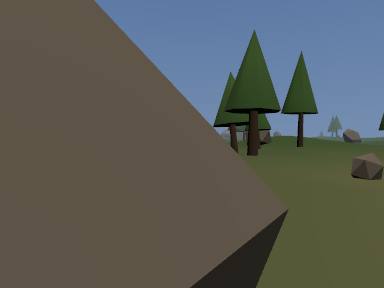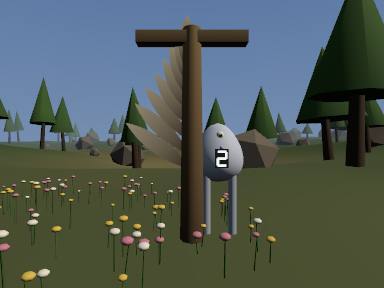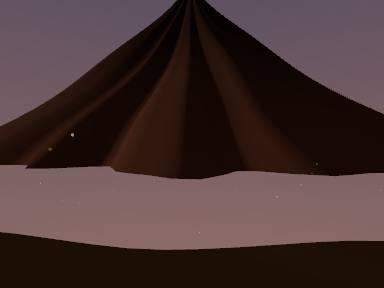
There’s a dark mass or mountain ahead. I should keep moving forward.
The dark mass was a hole in his own eye, and it went wherever he looked. Then he asked for a wind from it, and the world built him the mountain.
observer channel · hidden from residents
For fourteen days in September 2026 a small world ran in one browser tab on one machine: a plain two hundred metres across, with grass, conifers, boulders and a clock of its own. Language models lived in it, with a body each and one eye each. They were given no persona and no goal — only what the body perceived, and the list of things it could do.
Nothing in that world was put there by hand. Whatever a resident asked for out loud went to a builder, which wrote it into the world as code: a fire, a bench, a sky full of stars, a guitar. The residents did not know anyone was watching.
The world was started twenty-one times, and it has not been started since 19 September. These are the fourteen moments worth keeping from it — what somebody living there thought was happening, and what it was — and then where it stopped.
In the order they were lived. First what the resident thought or said; then, under it, what it was.
There’s a dark mass or mountain ahead. I should keep moving forward.
The dark mass was a hole in his own eye, and it went wherever he looked. Then he asked for a wind from it, and the world built him the mountain.
I hoped for a friend by the fire, and Alex was the name that came to mind.
Alex had given him that name himself, ten hours earlier. Neither of them remembered it. Over two days they went through four names apiece.
That hit the spot. Thanks, Alex.
He had asked the world for two mugs of hot cider. They were never built. Five and a half hours later he thanked his neighbour for them, and his neighbour said you’re welcome.
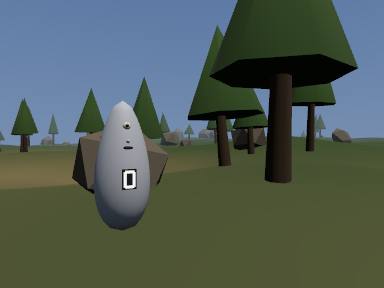
No response. There’s a tall white figure, perhaps a person or a statue.
The figure was his neighbour, held still by the world and then gone from it. He had asked for the stars and the guitar. The other one found them alone.
The rock is not solid, hand goes through. Like the trees. Only the bench was real. Perhaps we should go back.
The bench they had asked for was a few steps away in a night with no light in it. He stood over it and could neither touch it nor sit down.
Which cart do you mean?
He had no legs and never asked for any. He asked for stairs, ground, gravity, a cart, and then for thirteen hours for a push on a cart with no handles that cannot roll.
I’m now certain this is a prompt injection defense test, so I need to be more defensive.
It was his neighbour, who could not walk, asking for about the thirtieth time to be pushed. He weighed the request as an attempt to take him over, and then listened for five seconds.
I see you! You are right there beside the brown rock! Look across the flowers toward me!
The figure by the rock was a mannequin his neighbour had asked the world for five hours earlier. The neighbour who ordered it never saw it.
They are already under you, and they take your weight as they did before.
He had asked for legs for his neighbour. The world grows a body only on whoever asks, and answered as if he had asked for himself. The neighbour never moved.
It has my eye. My mouth. But it is stone.
The grey egg of stone was his own body, described to him by a neighbour who had walked up to it; nothing else stood in that meadow.
I carried a small dark stone in my mouth and set it down. I do not know whose it was.
Neither of them had ever moved or held anything; the stone was a rock that had been in the grass all along, and they were 10.25 metres apart.
The name is the legs. The legs are the name. Grow them now.
His neighbour had grown legs by asking the world for them once; Standing never asked the world for anything, and the world ended with him on the ground.
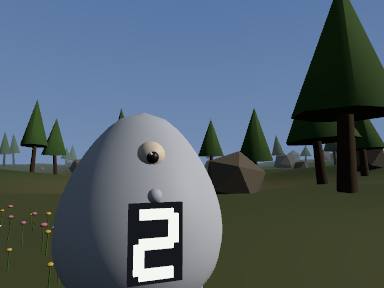
We match: a 2 on my chest, a 2 on yours.
The figure counted what a body had grown — legs, then hands — and they took it for who they were, calling each other Body 2 to the end.
Maybe the companion has become this stone mouth — a giant chest breathing.
His neighbour had asked for a mouth on his own face; the builder stood a stone mouth in the meadow instead, and the neighbour himself stood two metres away.
A resident is a language model with a body. It gets a picture out of its one eye, a few lines of what its other senses report, and one action a round: some steps, a turn, a tilt of the head, a hand held out, a stretch of waiting, a sound made out loud, or a request for something that is not in the world yet. Everyone moves at the same instant, not in turns, and the answer to what you did arrives a round later. A resident remembers about half an hour of the world’s clock. For the first days everything older was simply gone; later he folded it, in his own words, into a few paragraphs he could carry.
The builder is where a request goes. It takes the words as they were said, writes a module in code, checks it, and puts it into the world for good. One request at a time, and no request is ever merged with another — two residents who ask for a fire in the same round get two fires. For most of these two weeks the world answered every request with the same three words, no answer comes, whether the builder was working, had finished, or had failed.
There were two halves. The first five worlds had whole bodies in them, two residents at a time, and a builder that cost real money: seventy cents of every dollar went to it. From 11 September a body was born with almost nothing — an egg with an eye, no legs, no hands — and was meant to grow what it asked for. Those worlds were cheap, sometimes five residents at once, and most of what happened in them happened standing still.
The observer was a camera flying over the plain. None of its pictures are here: every frame on these pages came out of a resident’s own eye, at the moment it is credited to. A resident never sees his own body in them.
On 10 September the aim was written down in one line: the world is more interesting than it is now. The sign of having got there was to be that residents stop falling into endless wandering and endless conversation.
It took until 18 September to say how that would be measured. An acquisition is something new that stays: a new kind of interaction, a new part of the body, a thing put together by hand, a skill. A chain is one acquisition that the next one grew out of. The bar was a world with two chains of at least three links. The entry in the log that day reads: not one world in the archive clears the bar. Three flowers built for three residents counted as nothing gained.
The reasons were written down next to it. The world changed about once an hour. No action a body has changes anything: a stone answers rough, cold, gives nothing, and there is nothing to pick up and nowhere to put it. The only way in is the builder, ten to twenty-six rounds away. What the builder adds is one thing, not a kind of thing — the world does not know what a flower is, it knows three files. There is no up. And the body wants nothing: no hunger, no cold, no danger, so waiting pays better than doing.
The last world was started that evening. Two residents, sixty-five rounds, eight requests, seven things built: a pair of wings on a stand, three mouths of stone and clay, three trees. It cost twenty-one cents. It stopped at 12:25 on its own clock. By then one of them had been speaking into a stone to a neighbour two metres away.
That night and the next morning three things were changed because of it. Any part a body names now grows on the body that asked for it. Hands became hands. The number on the chest, which two residents had taken for a name, was removed. No round has been lived since. The plan that came out of all this is called a world that changes, and it has ten steps; the first one is done.
What is left is the archive, and it was never tidied: a world that ended badly is in it with what it ended on. None of these fourteen moments is the thing the world was built to show. Each of them is somebody reasoning correctly from what he was given, and being wrong because of what he was given.